
★ Grades 8–12 & College · Live Online Cohort · Hardware Kit · No Coding or Electronics Experience Needed
CanSat Space Engineering & Mission Control Lab
Build, Program and Operate Your Own Satellite Engineering Prototype.
Students assemble and program a working CanSat — a can-sized satellite engineering payload — with onboard sensors, GPS, data logging and wireless LoRa telemetry. They receive live mission data through a professional ground-station dashboard and run a real elevated-station mission — payload upstairs, ground station at the desk — capturing live altitude, atmospheric and radio data. Families who want to go further can add an optional tethered-balloon ascent or parachute drop using our checklist. No prior coding or electronics experience needed.
🛰️ Real hardware, yours to keep: build your CanSat + ground station from our published parts list (~$300 in parts), or add the ready-to-build Research Ignited kit ($500, shipped). Either way, the finished satellite is yours.
A natural progression
Continue into deeper Research Ignited pathways
From a first completed mission, to advanced labs, to 1:1 research mentorship — students can keep climbing.
✈️
Aerospace & Mission Design Lab
The broad foundation — flight science, drones, satellites and space-mission design.
🚀
Rocket & Launch Vehicle Design Lab
The computational specialization — design, simulate, quantify, defend.
🛰️
CanSat Space Engineering Lab
You are here. The hardware build — sensors, GPS, LoRa telemetry and a satellite prototype you keep.
🔬
Aerospace Research Fellowship
1:1 mentorship turning aerospace interest into an original research project.
None is a prerequisite for another — every programme starts from zero. Compare all three →
Real hardware. Real telemetry. Real systems engineering.
Students don't just learn about satellites — they engineer, program, and operate one.
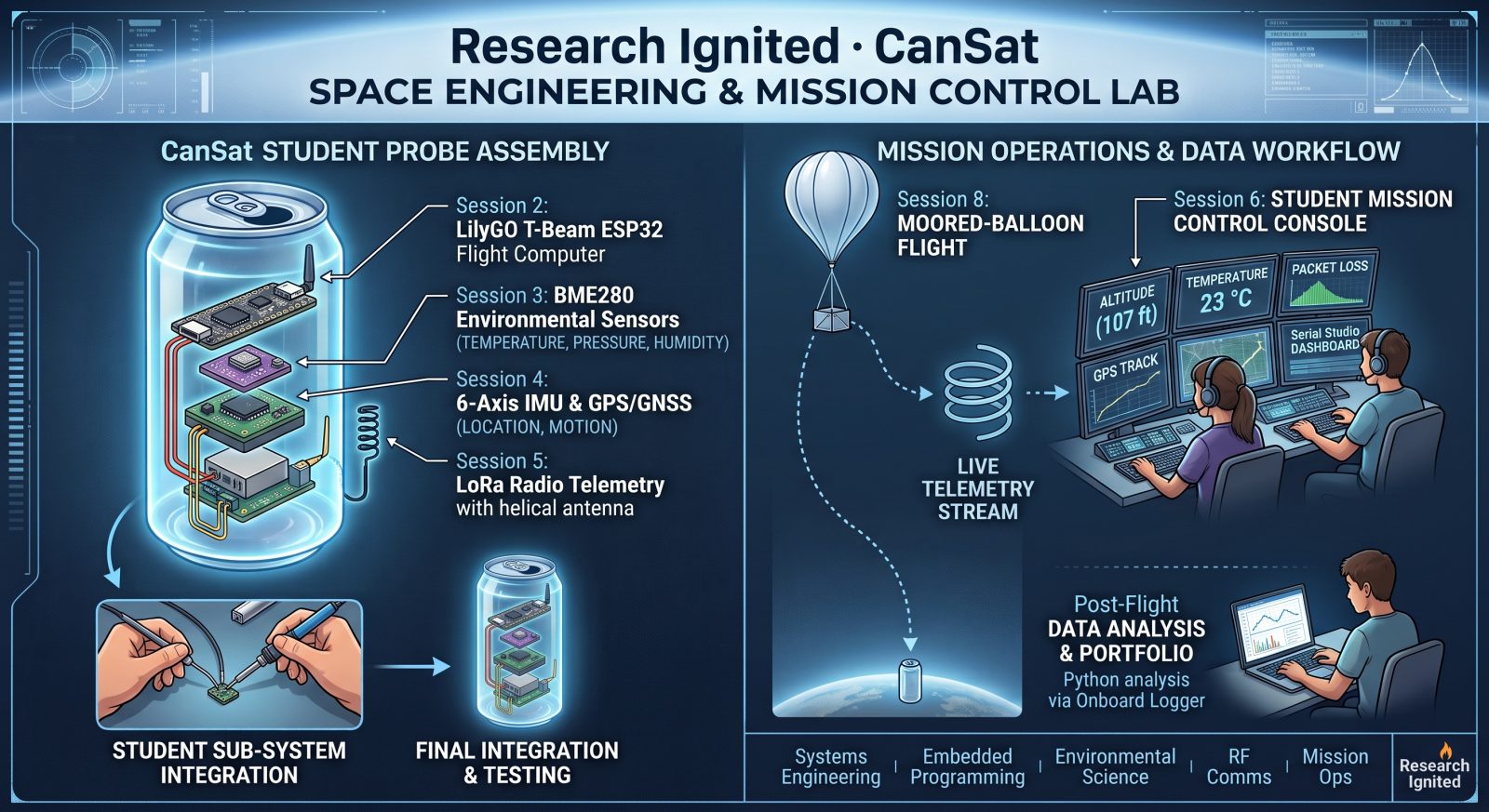
A CanSat is a fully functional satellite engineering prototype that fits inside a soda can. Students build and integrate the core subsystems found on real spacecraft — onboard computing, environmental and motion sensors, GPS navigation, power, radio telemetry, data logging, and a ground station — then run a live mission and analyze the data it sends back. It's the same systems-engineering workflow used on real space missions, scaled to a build you can complete in eight sessions (this is an atmospheric engineering payload, not orbital hardware).
🛠️
Engineer every subsystem
Flight computer, environmental & motion sensors, GPS, LoRa radio, power, and onboard data storage — wired, coded, and integrated by the student.
📡
Operate real mission control
Build a ground station that receives live telemetry over radio and displays it on a professional Serial Studio dashboard — altitude, temperature, GPS, signal strength, packet loss.
🎈
Run a live mission
Every student runs an elevated-station mission — payload upstairs, ground station at the desk — capturing real altitude, atmospheric and radio data, then presenting results like a mission engineer. Optional extensions families can run themselves: a tethered-balloon ascent or a parachute drop test.
🦾
Love hardware and want more? The AI Robotics & Autonomous Drone Lab builds programmable robots and drones, and the Aerospace Engineering & Mission Design Lab goes deep on flight science and space-mission design. Many students do CanSat alongside one of them.
The hardware
Real avionics-grade components — two ways to get them
The build uses genuine engineering hardware — the flight unit and a ground station. Tuition covers the instruction, software, mentoring and mission; the physical parts are sold separately — ~$300 if you source them yourself, or $500 for the ready-to-build Research Ignited kit — and you choose how to get them.
🧰 Build your own
- We publish the complete Bill of Materials — exact parts, models, and supplier links
- Source it yourself for roughly $300 in parts
- Great for makers who already have a 3D printer and basic tools
- You handle ordering, printing, shipping times and any wrong parts
- You'll have everything ready before Session 2
📦 Add the Research Ignited kit
- Tested, matched components + a pre-printed PETG CanSat frame, shipped ready to assemble
- $500, added at enrollment — U.S. shipping included
- No sourcing, no printing, no wrong-part delays, no guesswork
- Parts are verified against the class build, so your hardware matches the instructor's
- The simplest path — recommended for most students
🧠
Flight computer
LilyGO T-Beam (ESP32 + SX1262 LoRa radio, 915 MHz) with onboard GPS and 18650 power management — the payload's brain and transmitter.
🌡️
Sensor & data suite
BME280 (temperature, pressure, humidity), a motion IMU (accelerometer + gyroscope), and an onboard microSD logger for backup data.
📻
Ground station
A Heltec WiFi LoRa 32 V3 receiver with a built-in OLED showing packet count, RSSI, SNR, and mission state — connects to any laptop.
🛰️
Frame & power
A printed PETG CanSat frame with impact bumper, an 18650 rechargeable battery with safe charging, plus buzzer, status LED, and arming pin.
All software (Arduino/PlatformIO, Serial Studio, Python) is free and set up together in class. Students keep the finished satellite and ground station.
What students will do
Eight sessions, from mission plan to a completed flight mission
Each ~2-hour session pairs a real engineering concept with a hands-on build on the student's own hardware — and a concrete output that carries into the flight mission.
Session 1
CanSat Mission & Systems Engineering
ConceptThink like a mission teamWhat a CanSat is, how it relates to CubeSats and real satellites, subsystems, and the engineering design process.
BuildPlan your missionDefine objectives, write a requirements list, and sketch a subsystem block diagram.
OutcomeMission definitionA mission plan + requirements list + component map.
Session 2
Flight Computer & Embedded Programming
ConceptThe payload's brainMicrocontrollers, inputs/outputs, the ESP32 & LilyGO T-Beam, uploading firmware, the Serial Monitor.
BuildBoot the flight computerWire up the T-Beam, upload a starter program, and run a system self-test.
OutcomeA live boardA booting flight computer confirmed working.
Session 3
Environmental Sensors & Altitude
ConceptReading the atmosphereTemperature, pressure, humidity, the BME280, I²C, calibration, sensor noise, and estimating altitude from pressure.
BuildStream real dataConnect the BME280 and display live temperature, pressure, and humidity; calculate relative altitude.
OutcomeLive readingsEnvironmental data + a calculated altitude.
Session 4
Motion, Orientation & GPS
ConceptWhere it is & how it movesAccelerometer, gyroscope, IMU, GPS/GNSS, latitude/longitude, satellite fix, GPS vs. barometric altitude.
BuildTrack a missionRead the IMU, get an outdoor GPS fix, record a short walking mission, and plot the location data.
OutcomeA mapped trackA logged GPS + motion mission.
Session 5
LoRa Radio & Telemetry
ConceptTalking over radioRadio communication, LoRa, transmitter/receiver, frequency, antennas, telemetry packets, RSSI & SNR, packet loss.
BuildOpen a radio linkTransmit telemetry from the CanSat, receive it on the ground station's OLED, and run a range test.
OutcomeFirst telemetryA working two-way radio link.
Session 6
Mission-Control Dashboard & Logging
ConceptMission controlGround stations, Serial Studio, live graphs and gauges, CSV files, warning thresholds, battery & packet-loss monitoring.
BuildGo liveConnect the Heltec receiver to a laptop, view live data in Serial Studio, and save a mission dataset.
OutcomeA live dashboardA working mission-control view + a saved dataset.
Session 7
CanSat Assembly, Power & Testing
ConceptFlight readinessMechanical integration, the frame, battery safety, power management, center of mass, and a Flight Readiness Review.
BuildIntegrate the payloadAssemble the full CanSat, secure the electronics, and run a preflight checklist.
OutcomeFlight-readyA complete CanSat that passes its readiness review.
Session 8
Flight Operations & Mission Analysis
ConceptOperate & analyzeMission roles, go/no-go thinking, live telemetry operations, link performance, and post-mission analysis.
BuildRun the elevated-station missionPlace the CanSat at height — an upstairs window, balcony or stairwell — and run the ground station below. Capture a real altitude delta from barometric pressure, a live GPS fix, environmental data and RF link quality over distance, then compare transmitted vs. onboard-logged data. No helium, no field, no weather dependency.
OutcomeA completed missionA real mission dataset + a final results presentation.
OptionalGo higher, if you want toFour optional extensions families can run themselves with our checklist, in order of setup effort: an extension-pole hold (10–20 ft), a kite-lifted profile (40–80 ft, no gas needed), a tethered-balloon ascent, and a parachute drop test for descent rate and drag. None is required — the portfolio is complete without any of them.
Enroll now
Upcoming cohorts
The signature outcome
CanSat Engineering & Flight Mission Portfolio
Students don't just walk away with a device — they walk away with a complete engineering record. The program builds to a real, documented mission: the student's own CanSat streaming live data to the ground station they built, run from an elevated station — plus a complete flight-readiness package for the optional balloon and drop-test extensions.
The mission — then climb the ladder
Every student runs the core mission. Families choose how much further to go — each step adds altitude and a little more setup.
- Core · everyone: elevated-station mission (~10–20 ft) — payload upstairs, ground station below. Preflight checklist, Flight Readiness Review, live mission control, altitude delta from barometric pressure, RF link quality over distance, transmitted vs. onboard-logged comparison.
- Optional 1 · extension pole (10–20 ft): the CanSat secured to a telescoping pole and held upright outdoors. Micro-barometric deltas, temperature and airflow gradients — hardware in hand the whole time.
- Optional 2 · kite-lifted profile (40–80 ft): clipped below a single-line kite on a breezy day. A true continuous vertical profile plus IMU pitch/roll from aerodynamic buffeting — and no compressed gas anywhere.
- Optional 3 · tethered-balloon ascent: the classic CanSat profile, using our balloon safety checklist.
- Optional 4 · parachute drop test: descent rate and drag from a safe, cleared height.
All four are run by the family, not by Research Ignited, and none is required for completion, the portfolio or the certificate.
Your engineering portfolio includes
- Mission requirements
- Hardware architecture & subsystem/wiring diagram
- Source code
- Sensor-calibration results
- Telemetry specification
- Mission-control screenshots
- Flight-readiness checklist
- Atmospheric mission dataset
- Signal-strength & packet-loss analysis
- Final engineering report + capstone presentation
The core mission is an elevated-station test — the CanSat is placed at height indoors or at a home (an upstairs window, balcony or stairwell) while the ground station runs below. It needs no helium, no field, no permissions and no particular weather, so every student completes it. An adult should place and retrieve the payload; students should not climb onto roofs or lean from windows. The optional tethered-balloon ascent and parachute drop test are extensions conducted by the family, not by Research Ignited: we provide the mission-ops briefing, the safety checklist and the flight-readiness review, and the parent or guardian decides whether to do them, chooses the location and runs the activity. Where a family chooses an outdoor extension, our checklist covers each: an extension-pole hold uses a non-conductive fibreglass or wooden pole (never aluminium), and both the pole and kite options require a site check for overhead power lines — the single most serious hazard in either activity — plus gloves for kite line and no flying in wet or stormy conditions. A kite-lifted profile keeps the total kite and payload weight under five pounds, the point at which FAA kite rules begin to apply. For the balloon option our checklist specifies a small helium-rated, continuously tethered (moored) balloon flown low (well under 150 ft, the point at which FAA notice requirements begin for moored balloons), an envelope under 6 ft inflated diameter and under 115 cubic feet, a primary plus independent backup tether, no pyrotechnic or cut-down devices, calm conditions, and no operation within five miles of an airport, near power lines, or over roadways — never a free-flying, high-altitude or rocket-launched system. Helium is sourced locally by the family; Research Ignited does not ship compressed gas. Drop tests are conducted by an adult over a cleared area. These extensions are not required — completion, the portfolio and the certificate never depend on them, because every student has already captured real mission data from the elevated-station test and from earlier sessions. Lithium batteries are handled under adult supervision. Research Ignited LLC provides educational instruction and hardware; this is an atmospheric engineering payload, not orbital or space-qualified hardware, and Research Ignited does not operate crewed aircraft.
How we teach
Real engineering. Accessible delivery.
Every session follows the same three-beat rhythm, so students with zero background build real avionics without getting lost.
Beat 1The ConceptStart with the engineering idea — how a pressure sensor estimates altitude, why LoRa reaches so far, what a telemetry packet carries.
Beat 2The BuildWire it, code it, and see it work on your own hardware — guided step by step, with troubleshooting built in.
Beat 3The DataRead what the payload actually reports, decide what it means, and make the next engineering call.
Who it's for
Built for curious builders — advanced hardware, accessible delivery
Built for students in grades 8–12 and college undergraduates who like to build real things and want a genuine engineering challenge. No prior coding, electronics, or aerospace experience is required — everything is taught from scratch, so the same build works whether you are starting high school or already studying engineering.
- Curious about space, satellites, rockets, or how things fly
- Enjoys building, wiring, and making real hardware work
- Wants a hands-on STEM experience beyond a basic camp
- Interested in coding, electronics, or data — or wants to try them
- Considering engineering, computer science, aerospace, or physics
- Wants a standout, portfolio-ready project for applications
- An undergraduate who wants real flight-hardware experience alongside coursework
- Preparing for an aerospace internship, research role, or a university satellite team
Real-world skills & tools
The same building blocks used on real missions
Students leave fluent in a genuine embedded-systems and mission-data toolkit:
- Embedded programming on the ESP32 (Arduino / PlatformIO)
- I²C sensors — pressure, temperature, humidity, IMU
- GPS / GNSS positioning and satellite fixes
- LoRa radio telemetry, antennas, RSSI & SNR
- Serial Studio live mission-control dashboards
- Data logging to microSD and CSV
- Python for analyzing real flight data
- Systems engineering, testing & flight-readiness review
Where it can lead
Explore future pathways in space, engineering & data
A CanSat build opens doors across engineering and applied science:
- Aerospace & satellite engineering
- Electrical & computer engineering
- Embedded systems & robotics
- Mechanical & systems engineering
- Data science & sensor analytics
- RF / communications engineering
- Atmospheric & environmental science
- Space mission operations
Reserve your seat
CanSat Space Engineering & Mission Control Lab
A premium, hands-on engineering program — far more than eight online classes.
$999 / student tuition
8 live online sessions (~2 hrs each · ~16 live hours) · small cohort (capped ~10–12). Hardware kit sold separately (see right).
- 8 live sessions with an aerospace / embedded-systems instructor
- Guided assembly, firmware & dashboard setup
- Professional Serial Studio mission-control dashboard
- Technical support throughout the build
- Flight-readiness (mission-readiness) review
- Live telemetry mission + mission-ops briefing & safety checklist
- CanSat Engineering & Flight Mission Portfolio
- Final engineering presentation & certificate of completion
🧰 Hardware kit
$300–$500 · sold separately
The physical CanSat + ground-station components. Required for the build — get them whichever way suits you:
Build your own · ~$300
We publish the full parts list with supplier links — source, print and order it yourself.
Add the RI kit · $500
Tested, matched parts + a pre-printed frame, shipped ready to assemble, U.S. shipping included. Recommended.
Students keep the finished satellite and ground station.
Tuition ($999) covers instruction, software setup, technical support, the flight mission, portfolio guidance, and certification. The hardware is required and sold separately: self-sourced from our published Bill of Materials for approximately $300 in parts, or purchased as the ready-to-build Research Ignited kit for $500 with U.S. shipping included (specific components may be substituted with equivalents based on availability). Self-sourced part costs are an estimate and vary with supplier pricing and availability. A parent or guardian supervises battery charging, places and retrieves the payload for the elevated-station mission, and conducts any optional outdoor extension the family chooses — Research Ignited does not operate, supervise or schedule it. Lithium-battery handling and the tethered balloon activity follow the safety guidance we provide and are subject to weather, location, and local rules.
Questions students & parents ask
Good to know
Does my student need coding or electronics experience?+
No. The program is built for complete beginners, whether that is a grade-8 student or a college undergraduate. Programming, wiring, sensors, and radio are all taught from scratch, step by step, on the student's own hardware.
I'm a college student (or an adult) — can I join?+
Yes. Undergraduates and adult learners are welcome, and we have seen strong interest from college students in our aerospace programs. The engineering is the same at any age: the build is real flight-grade hardware, the systems-engineering workflow is the one used on real missions, and nothing about the curriculum is watered down for a younger audience. Cohorts do include high school students, so if you would prefer to be grouped with other college-level builders, mention it when you enroll or talk to an advisor and we will place you accordingly.
Is the hardware included in tuition?+
No — tuition ($999) covers the live instruction, software, mentoring, the flight mission, and the engineering portfolio. The physical components are sold separately: build it yourself from our published parts list for roughly $300 in parts, or add the ready-to-build Research Ignited kit for $500 at enrollment (tested, matched parts, pre-printed frame, U.S. shipping included). Either way, students keep the finished satellite and ground station.
Does my student have to fly a balloon outdoors?+
No. The core mission every student runs is an elevated-station test: the CanSat sits at height — an upstairs window, a balcony, a stairwell — while the ground station runs downstairs. That gives a real barometric altitude delta, a live GPS fix, environmental data and a genuine radio link over distance, with no helium, no field, no permissions and no weather dependency. An adult should place and retrieve the payload; students should not climb onto roofs or lean from windows.
Four optional extensions exist for families who want more altitude, in order of setup effort: an extension-pole hold (10–20 ft, hardware in hand the whole time), a kite-lifted profile (40–80 ft, no compressed gas at all), a tethered-balloon ascent, and a parachute drop test. For the pole and kite options the checklist requires a site check for overhead power lines — the most serious hazard in either — a non-conductive pole rather than aluminium, gloves for kite line, no wet or stormy conditions, and total kite-plus-payload weight under five pounds, the threshold at which FAA kite rules begin. All four are conducted by the family, not by Research Ignited — we provide the briefing, the safety checklist and the flight-readiness review; the parent or guardian decides whether to do them, picks the location and runs the activity. Where a family chooses the balloon, our checklist calls for a small helium-rated, continuously tethered (moored) balloon flown low (well under 150 ft, where FAA notice requirements begin for moored balloons), an envelope under 6 ft inflated, a backup tether, calm wind, and no operation within five miles of an airport. It is never a free-flying, high-altitude or rocket-launched system, and no cut-down or pyrotechnic devices are used.
None of them is required. Completion, the portfolio and the certificate never depend on them — every student has already captured real telemetry from the elevated-station mission, plus logged datasets from the GPS mission in Session 4 and the mission-control session in Session 6.
Is this a real orbital satellite?+
No. A CanSat is a can-sized satellite engineering prototype used to teach the same subsystems and workflow real spacecraft use — flight computer, sensors, power, telemetry, and a ground station. It is an atmospheric engineering payload, not orbital or space-qualified hardware.
What is the difference between a CanSat and a CubeSat?+
A CanSat is an educational satellite engineering platform built into the volume of a beverage can and flown on an atmospheric mission — that is what students build here. A CubeSat is a standardized nanosatellite built from 10 cm cube modules for actual orbital spaceflight, and is normally a university, research-team or agency-scale project. They share the engineering: subsystems, embedded flight software, power, radio telemetry, ground stations, testing and mission operations. See the full comparison below.
Do we need a 3D printer or special tools?+
Only if you choose to build your own kit. The Research Ignited kit ships with the frame already printed and the parts included. Assembly uses simple, common tools, and each step is guided in class.
How is the program scheduled?+
Eight live online sessions of about two hours each (~16 live hours total), in a small cohort. See the Upcoming Cohorts section above for current dates.
What will my student have at the end?+
A working CanSat, a real dataset from a completed flight mission, a mission-control dashboard they built, and a full CanSat Engineering & Flight Mission Portfolio with a final engineering presentation — a genuine, application-ready STEM project.
How does this connect to your other programs?+
CanSat pairs naturally with the Aerospace & Mission Design Lab and the AI Robotics & Drone Lab, and students who want mentor-guided research can continue into the Aerospace Research Fellowship.
Understanding small-satellite engineering
From CanSat to CubeSat: how student satellite engineering works
Small satellites gave a generation of engineers their first real flight hardware. Two platforms dominate student and early-career work — the CanSat and the CubeSat. They are not the same thing, and knowing exactly how they differ is part of the engineering literacy this program builds.
What is a CanSat?
A CanSat is an educational satellite engineering platform packaged into the volume of a beverage can. It carries the same classes of subsystem a spacecraft carries — an onboard flight computer, a sensor suite, power, a radio downlink and a ground station — and flies an atmospheric mission rather than an orbital one.
- Atmospheric engineering payload — ground, tethered-balloon or rocket-carried missions
- Can-sized, built from off-the-shelf avionics-grade components
- Teaches subsystem integration, telemetry and mission operations end to end
- Affordable enough for a student to build, fly, recover and keep
What is a CubeSat?
A CubeSat is a standardized small satellite — a nanosatellite — built for actual spaceflight and assembled from 10 cm cube modules that fit a common deployer interface. NASA's CubeSat Launch Initiative has carried CubeSats built by universities, schools and non-profits to orbit as auxiliary payloads.
- Spaceflight hardware, designed and licensed for orbital missions
- Standardized cube-module form factor and deployer interface
- Needs space-qualified parts, radiation, thermal and power-budget analysis
- Typically a university, research-team or agency-scale project
🛰️
Where this program sits: students build a CanSat — a real, working satellite engineering prototype, run as an elevated-station mission, with optional family-run balloon and drop-test extensions. It is not orbital or space-qualified hardware, and we are careful not to claim otherwise. What does carry forward to CubeSat and spacecraft work is the engineering itself: writing mission requirements, integrating subsystems, programming an embedded flight computer, closing a radio link, streaming telemetry into a ground station, testing against a flight-readiness checklist, and analyzing the dataset a mission actually returns.
What is inside a student-built CanSat?
The flight unit and ground station in this lab are built from the same components used in real amateur and research telemetry work — no toy kits, no black boxes.
- Flight computer — an ESP32-based T-Beam board, programmed in Arduino / PlatformIO
- Environmental sensing — a BME280 for pressure, temperature and humidity, with pressure-derived altitude
- Motion & orientation — an IMU for acceleration and attitude during the mission
- Navigation — onboard GPS / GNSS for position, fix quality and ground track
- Radio downlink — LoRa telemetry, with link budget, antennas, RSSI and packet-loss analysis
- Ground station — a Heltec receiver feeding a live Serial Studio mission-control dashboard
- Onboard storage — microSD data logging to CSV, so no data is lost if the link drops
- Analysis — Python to turn the recovered flight dataset into real engineering conclusions
Build your own CanSat and operate a live mission-control system.
Engineer a working satellite prototype, run real mission control, and complete a documented flight mission — with an engineering portfolio to show for it.