
CanSat vs CubeSat is one of the most common points of confusion for students getting into satellite engineering — and getting it right matters, because the two platforms sit at completely different points on the learning curve. One you can build on a kitchen table in eight weeks for a few hundred dollars. The other is real spaceflight hardware that typically costs tens of thousands of dollars to build and launch.
Short answer: A CanSat is an educational satellite engineering platform built into the volume of a soft-drink can, flown on a rocket, drone or balloon inside the atmosphere. A CubeSat is a standardized small satellite built from 10 cm cube units and designed to operate in orbit. A CanSat teaches the engineering; a CubeSat flies the mission. Almost every student who works on a CubeSat started with something CanSat-shaped first.
This guide breaks down exactly how they differ — physically, financially, and educationally — plus the competitions you can actually enter, what you learn from each, and how to build a realistic path from your first sensor to a real space-systems career.
What is a CanSat?
A CanSat is a simulation of a real satellite, integrated within the volume and shape of a soft-drink can. The challenge is to fit the major subsystems found in a satellite — power, sensors, onboard computing and communications — into a container roughly the size of a 350 ml can.
Once it is released, from a rocket, a drone or a tethered balloon, the CanSat performs a mission: it collects data, transmits telemetry to a ground station, and lands safely. Students then analyse what came back and report on it, exactly as a mission team would.
The idea is older than most people assume. In 1998, roughly 50 students and faculty from a dozen universities in the United States and Japan met at the University Space Systems Symposium in Hawaii, where Professor Bob Twiggs of Stanford University proposed launching a structure the size of a soda can — around 350 ml in volume and about 500 g in mass. That proposal grew into ARLISS, a collaboration between North American and Japanese universities that flew its first launch in September 1999 and has run annually ever since.
The key thing to understand: a CanSat is not a satellite. It never reaches orbit and it is not space-qualified. What it reproduces faithfully is the engineering workflow — requirements, subsystem integration, testing, launch operations, telemetry and data analysis.
What is a CubeSat?
A CubeSat is a standardized small satellite — a class of nanosatellite — built from modular 10 cm cubes. One cube is called a “1U.” Larger spacecraft are built by stacking units: 2U, 3U, 6U and 12U are all common.
The standard was created in 1999 as a collaboration between Professor Jordi Puig-Suari at California Polytechnic State University (Cal Poly), San Luis Obispo, and Professor Bob Twiggs at Stanford — the same person behind the CanSat concept. That is not a coincidence: the two platforms were designed by overlapping people to solve the same problem, which was that building a satellite had become far too expensive for a student to ever touch one.
Mass limits have moved as the specification matured. Revision 13 of the CubeSat Design Specification capped a 1U at 1.33 kg; Revision 14.1 raised it to 2 kg per unit. The dimensional standard is what makes the whole ecosystem work — because every CubeSat presents the same interface, they can ride to orbit in standardized deployers as secondary payloads.
In the United States, NASA’s CubeSat Launch Initiative (CSLI) is the main route to orbit for schools and non-profits. It has selected more than 200 CubeSat projects from 42 states, the District of Columbia and Puerto Rico, and has launched over 150 CubeSats across more than 40 ELaNa (Educational Launch of Nanosatellites) missions.
CanSat vs CubeSat: the complete comparison
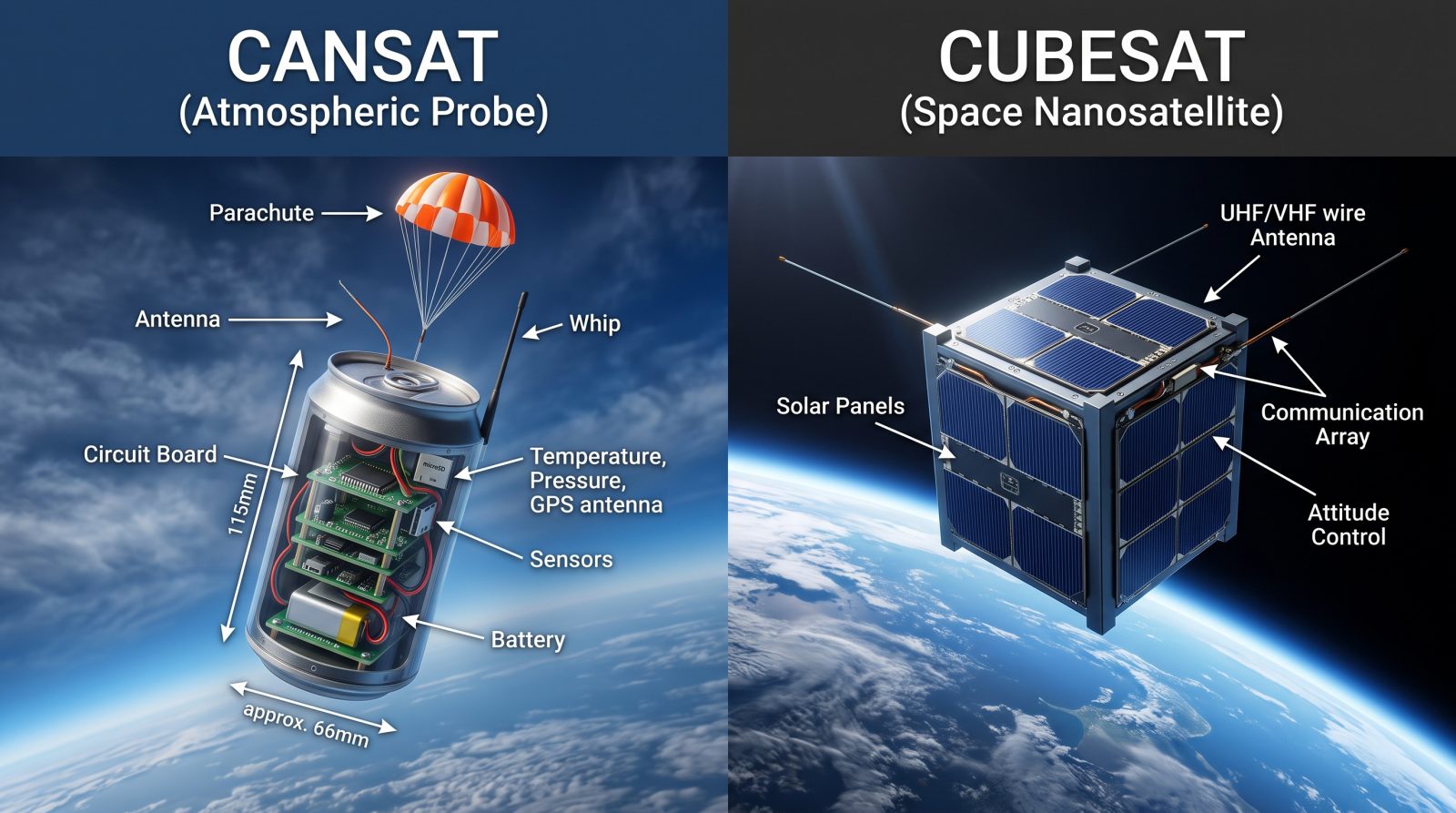
| CanSat | CubeSat | |
|---|---|---|
| What it is | Educational satellite engineering platform | Real spaceflight hardware |
| Where it flies | Inside the atmosphere — rocket, drone or balloon | Low Earth orbit and beyond |
| Size | ~350 ml soft-drink can | 10 cm cube units (1U, 2U, 3U, 6U…) |
| Typical mass | Roughly 300–500 g | Up to 2 kg per unit (CDS Rev. 14.1) |
| Mission duration | Minutes | Months to years |
| Build cost | A few hundred dollars | $2,000–$5,000 basic; $50,000–$200,000 institutional |
| Launch cost | Effectively none | Roughly $40,000–$90,000 per 1U |
| Time to fly | Weeks to one school year | Two to four years, typically |
| Who builds them | Secondary school and undergraduate students | Universities, agencies, companies |
| Regulatory load | Minimal — local flight safety rules | Radio licensing, orbital debris compliance, launch integration |
| Recoverable? | Yes — you get the hardware back | No — it stays in orbit, then re-enters |
The five differences that actually matter
1. One survives a fall. The other survives space.
This is the real engineering divide. A CanSat has to withstand ascent, deployment and landing — shock, vibration and a few minutes of weather. A CubeSat has to survive vacuum, radiation, thermal cycling between sunlight and shadow every 90 minutes, and years without a single repair. That one requirement is what drives CubeSat costs, timelines and testing regimes.
2. You can hold a CanSat again.
Recovery sounds like a small detail and is actually a huge educational advantage. When your CanSat lands, you open it, read the microSD card, see which sensor drifted, and fix it. A CubeSat team gets one shot; if a subsystem fails on orbit, the mission is simply over. Iteration is the fastest way to learn engineering, and only one of these platforms allows it.
3. The cost gap is roughly a factor of 100.
A student CanSat is a few hundred dollars of components. A basic student CubeSat runs $2,000–$5,000 to build, institutional builds land between $50,000 and $200,000, and launching a single 1U to low Earth orbit costs somewhere around $40,000–$90,000 depending on the provider. That is why CanSats exist: they make the same engineering reachable without a grant.
4. Timelines are wildly different.
A CanSat goes from mission plan to flight data inside a school term. A CubeSat program typically runs two to four years from concept to launch — long enough that undergraduate team members often graduate before their own satellite flies. For a high school or first-year student, that difference decides whether you finish anything at all.
5. The subsystems are genuinely the same.
Here is why CanSat experience transfers. Both platforms need an onboard computer, a power system, sensors, a radio link, data storage and a ground station. Both need requirements written down, integration testing, a flight-readiness review, and post-mission data analysis. Change the environment and the budget, and you have changed the difficulty — not the discipline.
⭐ Featured · Research Ignited
🛰️ CanSat Space Engineering & Mission Control Lab
📍 Format: Online · Live · Small cohort
👥 Level: Grades 8–12 & college · No experience required
Build, program and operate a real CanSat over eight live sessions. Students wire and code an ESP32-based flight computer, integrate environmental and motion sensors with GPS, transmit live telemetry over a LoRa radio link, build their own ground station and mission-control dashboard, and complete a documented flight mission on a controlled tethered balloon ascent. Everyone finishes with a working satellite engineering prototype they keep, plus a full CanSat Engineering & Flight Mission Portfolio.
How much does a CanSat or CubeSat actually cost?
Cost is usually the deciding factor, so it is worth separating clearly.
A CanSat is built from commercial off-the-shelf parts: a microcontroller board, a barometric pressure and temperature sensor, an inertial measurement unit, a GPS module, a radio, a battery, a microSD card and a printed frame. Sourced individually this typically lands in the low hundreds of dollars, and there is no launch cost — a drone, a small rocket or a tethered balloon does the job.
A CubeSat has three separate cost centres, and people routinely forget the third:
- Hardware — $2,000–$5,000 for a basic student build; $50,000–$200,000 for an institutional-grade spacecraft.
- Launch — roughly $40,000–$90,000 per 1U to low Earth orbit.
- Everything else — environmental testing, radio licensing, orbital debris analysis, launch integration paperwork and ground-segment operations. On real programs this is often the largest line of all.
For students in the United States, NASA’s CubeSat Launch Initiative can cover launch for selected educational and non-profit missions — which is precisely why it exists, and why more than 200 projects have been selected through it.
CanSat and CubeSat competitions students can enter
Competitions are the most common on-ramp, but eligibility rules trip people up constantly. Check before you build a plan around one.
The European CanSat Competition (ESA). Run by the European Space Agency for secondary school students aged 14–19 across its Member and Associate States. Teams fit a satellite’s essential subsystems into a 350 ml can and fly two missions: a mandatory primary mission transmitting air temperature and pressure at least once per second, and a secondary mission of the team’s own design. Important for readers outside Europe: this competition is limited to ESA Member and Associate States, so students in the United States are generally not eligible.
The AAS Student CanSat Competition. Run annually by the American Astronautical Society, this is the flagship international CanSat competition — and it is predominantly a university event. High school participation is possible but rare: in the 2026 competition, a team from Thailand was the sole high school team to reach the finals. Treat it as an ambitious target rather than a first step.
CubeSat routes. There is no equivalent beginner-level CubeSat competition. The realistic student path to orbit runs through a university satellite team applying to a program such as NASA’s CubeSat Launch Initiative — which is exactly why building CanSat skills before university is such a practical advantage.
Is a CanSat a real satellite?
No — and it is worth being precise, because this is where a lot of marketing gets sloppy. A CanSat does not reach orbit, does not use space-qualified components, and is not subject to spacecraft licensing. ESA itself defines a CanSat as a simulation of a real satellite.
What is genuinely real is the hardware and the engineering. The sensors are real sensors, the radio link is a real radio link with a real link budget, the telemetry is real telemetry with real packet loss, and the failure modes are real failure modes. Students are not clicking through a simulator — they are debugging an I²C bus at 11pm because one sensor stopped answering. That experience transfers directly.
What students actually learn from a CanSat build
A well-run CanSat project covers the same subsystem map as a spacecraft:
- Onboard computing — embedded programming on a microcontroller such as an ESP32, in Arduino or PlatformIO.
- Environmental sensing — pressure, temperature and humidity, plus pressure-derived altitude.
- Attitude and motion — accelerometer and gyroscope data through an IMU.
- Navigation — GPS/GNSS position, fix quality and ground track.
- Communications — LoRa radio telemetry, antennas, link budget, RSSI, SNR and packet-loss analysis.
- Data handling — onboard microSD logging, so nothing is lost when the link drops.
- Ground segment — a receiver and a live mission-control dashboard.
- Systems engineering — requirements, integration, testing, flight-readiness review, and analysis of the data the mission returns.
That list is not a simplified version of spacecraft engineering. It is spacecraft engineering, scaled to a budget and a timeline a student can finish.
The realistic path: CanSat to CubeSat to career
If the long-term goal is aerospace engineering, the sequence that works looks like this:
- Build a CanSat. Learn embedded programming, sensing, radio and mission operations on hardware you can hold, break and fix.
- Go deeper on mission design. Add the theory a CanSat cannot teach — aerodynamics, orbital mechanics, spacecraft subsystems and trade-off analysis.
- Do original research. Turn the interest into a documented project: satellite data analysis, Earth observation, autonomy, or a mission concept study.
- Join a university CubeSat team. Arrive already able to read a datasheet, close a link budget and write a test plan — which is what those teams are actually short of.
⭐ Featured · Research Ignited
✈️ Aerospace Engineering & Mission Design Lab
📍 Format: Online · Live · 6-week cohorts
👥 Level: Grades 7–12 · No prior experience required
A structured, college-level foundation in aerospace engineering. Each live session pairs a core concept — aerodynamics, aircraft systems, aviation weather, drones and autonomy, satellites and orbital mechanics — with a hands-on lab on college-level simulators, building to a student-designed Capstone Mission Design Defense. The natural companion to a hardware build: the CanSat lab teaches you to make a payload work, this teaches you to design the mission around it.
⭐ Featured · Research Ignited
🔬 Aerospace Research Fellowship
📍 Format: Online · 1:1 mentorship · Rolling admission
👥 Level: Grades 9–12 (best for 10–12)
One-on-one mentorship that turns an aerospace interest into a portfolio-ready research project — aviation safety, autonomous drones, satellite data and Earth observation, CubeSat mission design, space medicine, sustainable aviation, or AI for aerospace. Students produce a research paper, technical poster or presentation. The natural next step after a build or a lab.
Frequently asked questions
Which is better for a high school student, a CanSat or a CubeSat?
A CanSat, in almost every case. It finishes inside a school term, costs a few hundred dollars instead of tens of thousands, and gives you hardware you can recover and improve. CubeSat work realistically begins at university.
Can a high school student build a CubeSat?
Building one is possible; flying one is the hard part. Launch costs and the regulatory workload mean orbital CubeSat projects are almost always run by universities, agencies or companies. Some school groups contribute to a university-led mission, which is a far more achievable route.
Do CanSats go to space?
No. CanSats fly inside the atmosphere and are recovered afterwards. They are educational engineering payloads, not orbital spacecraft.
How long does it take to build a CanSat?
A guided program can take a complete beginner to a finished flight mission in about eight weeks. A competition entry usually runs across a full school year because of the design reviews.
What programming language is used for a CanSat?
Most student CanSats are programmed in C++ through the Arduino framework or PlatformIO, with Python used afterwards to analyse the recovered flight data.
Does CanSat experience help with university applications?
It helps most when it is documented. A completed build, a real dataset, a mission-control dashboard you wrote and a written engineering report demonstrate far more than a certificate of attendance — and they give you something specific to talk about in an interview.
What is the difference between a CubeSat and a nanosatellite?
“Nanosatellite” is a mass class, generally 1–10 kg. “CubeSat” is a specific standardized form factor within that class. CubeSats in that mass range are nanosatellites, but not every nanosatellite is a CubeSat.
The bottom line
CanSat and CubeSat are not competitors — they are consecutive steps. The CanSat exists because building a real satellite was out of reach for students, and the CubeSat exists because building a real spacecraft was out of reach for small institutions. Both were created by an overlapping handful of people solving the same access problem at different scales.
If you are a student wondering where to start, the honest answer is that nobody starts with a CubeSat. Start with the can. Wire the sensor, close the radio link, watch your own telemetry arrive on a dashboard you built, then recover the payload and work out why one channel drifted. That is the experience that makes every next step possible.
Ready to build your first satellite engineering prototype?
Research Ignited runs live, small-cohort aerospace programs for students in grades 8–12 and college — hardware builds, mission design, and 1:1 research mentorship.